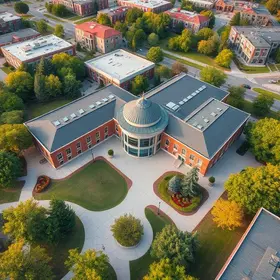
- For 67 years, City College of San Francisco has served the needs of its city in the truest populist tradition. Its goal of "providing educational and cultural opportunities to a diverse and changing community". With 85,000 students spread across nine city-wide campuses, its success is very "down to earth". This multicultural and generational, fully-accredited community college, is one of the largest in the country.
School Highlights
City College of San Francisco serves 19,267 students (27% of students are full-time).
The college's student-teacher ratio of 33:1 is lower than the state community college average of 44:1.
Minority enrollment is 78% of the student body (majority Asian and Hispanic), which is more than the state average of 77%.
Quick Facts (2026-27)
- Enrollment: 19,267 students
- In-state tuition: $1,290
- Out-state tuition: $7,246
- Student-teacher ratio: 33:1
- Minority enrollment: 78%
- Source: Integrated Postsecondary Education Data System (IPEDS)
Top Rankings
City College of San Francisco ranks among the top 20% of public schools in California for:
School Overview
The teacher population of 587 teachers has declined by 59% over five years.
City College of San Francisco
(CA) Community College Avg.
Carnegie Classification
Associate's Colleges
Associate's Colleges: High Transfer-High Traditional
Institution Level
At least 2 but less than 4 years
At least 2 but less than 4 years
Institution Control
Public
Public
Total Faculty
587 staff
72 staff
School Calendar
School Motto
'Of the People, for the People of San Francisco.'
Student Body
The student population of City College of San Francisco has stayed relatively flat over five years.
The student-teacher ratio of 33:1 has increased from 17:1 over five years.
The City College of San Francisco diversity score of 0.77 is more than the state average of 0.00. The school's diversity has stayed relatively flat over five years.
Total Enrollment
19,267 students
2,140 students
Student-Teacher Ratio
33:1
44:1
# Full-Time Students
5,236 students
1,022 students
# Part-Time Students
14,031 students
5,816 students
# Enrollment Undergraduate
19,267 students
2,055 students
# Full-Time Undergraduate Students
5,236 students
967 students
# Part-Time Undergraduate Students
14,031 students
5,816 students
% Asian
30%
12%
% Hispanic
28%
46%
% Black
7%
7%
% White
22%
23%
% Hawaiian
1%
n/a
% Two or more races
5%
5%
% Non Resident races
1%
1%
% Unknown races
5%
6%
Diversity Score
0.77
0.00
College Completion Rate (Students who graduate in less than 4 years)
37%
42%
Average Graduate Earnings (10 Years)
$42,900
$34,700
Tuition & Financial Aid
The public in-state tuition of $1,290 is more than the state average of $1,236. The in-state tuition has grown by 10% over four years.
The public out-state tuition of $7,246 is more than the state average of $6,577. The out-state tuition has declined by 16% over four years.
In-State Tuition Fees
$1,290
$1,236
Out-State Tuition Fees
$7,246
$6,577
% Students Receiving Some Financial Aid
56%
85%
Median Debt for Graduates
$10,500
$10,500
Median Debt for Dropouts
$7,771
$6,272
Source: 2025 (or latest year available) Integrated Postsecondary Education Data System (IPEDS) , School Administrators
School Notes
- City College of San Francisco (CCSF) offers courses in more than 50 academic programs and over 100 occupational disciplines. There is a full range of credit courses leading to the Associate of Arts and Science degrees, most of which meet the general education requirements of four-year colleges and universities. Occupational courses and programs prepare students for immediate employment. Free noncredit courses such as English as a Second Language and Citizenship, as well as classes designed for Older Adults, are also available. Competitively priced, short-term community service courses meet the training needs of business, industry and government, and personal enrichment of community members. City College has seen many of its students go on to successful careers in a variety of high profile fields, including theater, journalism, science, and professional sports. With its history of innovative curriculum, awards for an excellence, and an impressive roster of loyal alumni, City College continues to make good on its promise. Learning Assistance Center programs provide students with academic support services. The Learning Assistance Center offers a variety of services including tutoring, study groups and workshops. Our labs include a reading lab, a writing lab and three computer labs. We offer college success courses, career success courses and a tutor training course. Online courses provide students an opportunity to learn in an environment that is physically remote from professors and fellow students, but often at the same time surprisingly close and personal. These courses will open the classroom to a world of dynamic, diverse content. However, you also should understand that online courses are not for everyone. To succeed, you have to be self-motivated, possess good study skills, and be an independent learner. Most students find that online courses are as challenging as on-campus courses.
Frequently Asked Questions
How much does City College of San Francisco cost?
City College of San Francisco's tuition is approximately $1,290 for In-State students and $7,246 for Out-State students.
What is City College of San Francisco's ranking?
City College of San Francisco ranks among the top 20% of community college in California for: Diversity in US community colleges and Largest student body.
In what neighborhood is City College of San Francisco located?
City College of San Francisco is located in the Sunnyside neighborhood of San Francisco, CA.
Recent Articles

Online vs. Hybrid vs. HyFlex: Understanding Community College Course Formats
Learn what online, hybrid, HyFlex, synchronous, and asynchronous course labels really mean at community colleges, including attendance, meeting, testing, and participation requirements students should verify before registering today.

Working Student Schedule Test: Night and Online Community College Programs
Learn how working students can test whether a community college program is truly available at night or online, including labs, prerequisites, exams, internships, advising, and course rotations.

Is the Employer Advisory Board Real or Ceremonial?
Learn how to evaluate a community college employer advisory board, verify industry participation, identify meaningful employer influence, and determine whether career connections can benefit students after graduation today.