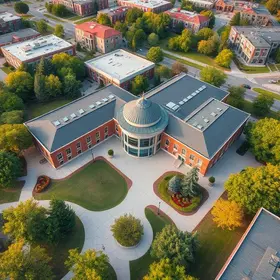

The face of college education in America is changing, especially on community college campuses. While community colleges were once unfairly labeled as “13th grade,” these two-year institutions now provide opportunities for high-achieving students to challenge themselves. Indeed, many high school valedictorians and honors students are enrolling in community colleges after high school.
Community Colleges Increasingly Serving the Best and the Brightest
Prompted partly by economic concerns, several top high school students are choosing to forego enrollment at prestigious four-year universities in favor of spending their first two years in an honors program at a community college. Indeed, the savings can be dramatic, and these students can save $80,000 by attending community college first instead of a private college.
These honors programs, most highly selective and academically rigorous, are designed to provide academically talented students with intellectual challenges for an affordable price. They are more popular now than ever.
This video explains honors programs.
Honors Programs at Two-Year Colleges Are Thriving
A recent article in the Washington Post reported that applications to community college honors programs are growing quicker than general applications, which are also rising. Honors programs of particular note include:
The Montgomery Scholars program of Maryland's Montgomery College. This highly selective program, which is ten years old, has only 25 seats available and received a record 275 applications for Fall 2009, according to the Post.
The Rouse Scholars program at Maryland's Howard Community College. The program is in its eighteenth year and includes study-abroad opportunities.
The Maricopa Community College Honors Program in Tempe, Arizona. This college builds its honors program each year around the annual study topic chosen by Phi Theta Kappa, the national honors society for two-year college students. The study topic for the 2009-2010 year is "The Paradox of Affluence: Choices, Challenges, and Consequences," and will serve as the organizing principle for the honors program throughout the academic year.
The Henry Ford II Honors Program at Henry Ford Community College in Dearborn, Michigan. As a highly competitive program, high school seniors are encouraged to apply early. Upon acceptance, participants work directly with faculty mentors who guide them through independent projects during their first two years and help them gain admission to leading four-year universities.
The Honors Program at Elgin Community College in Elgin, Illinois. High school students who graduated in the top 20% of their class and meet SAT and GPA requirements can apply for the honors program, allowing participants to enjoy smaller classes and greater educational opportunities outside the classroom walls.
This video looks at honors programs from another perspective.
Why High-Achieving High School Students Choose the Two-Year College Route
In weighing the acceptance letters between four-year universities and honors programs at community colleges, many high-achieving high school students choose the latter for various reasons.
Small class sizes. Newsweek reports that students may choose the two-year college route for more than purely financial reasons; community colleges' traditionally smaller class sizes can also make for "a more nurturing environment." For example, the Anne Arundel Community College Honors program boasts on its website that its classes are limited to 15 students only, which is a dramatic difference compared to the 300 students you can find in a public university’s lecture hall.
Potential to transfer to prestigious four-year universities. Prestigious four-year universities are increasingly eager to accept high-achieving transfer students from two-year colleges. For example, the Washington Post reports that Howard Community College has a formal transfer agreement with Dickinson College, a competitive liberal arts school in Carlisle, Pennsylvania. Even if it does not include a formal transfer agreement, an honors program can greatly help a student's chances of transferring to a selective four-year college or university. The website for the honors program for the North Shore Community College of Massachusetts reports that graduates of its program have transferred to Smiths, Tufts, Wellesley, Boston University, and the University of Massachusetts.
Value. Those who seek out the intellectual challenges of honors programs at two-year colleges often find an unbeatable educational value. According to the Washington Post, students who enroll in honors programs at two-year colleges can complete half their undergraduate education requirements for about $8,000, which is much more affordable than public and private four-year institutions.
Intellectual Community. Some parents and teachers may advise students against choosing the two-year college route, fearing that students will miss out on learning opportunities from other bright students at a four-year college. However, honors programs often offer their students a robust intellectual community. The Honors Experience Program at the Northern Essex Community College in Massachusetts is one of many programs where honors students have the opportunity to participate in specially organized social and cultural events and access a specially designated Honors Lounge.
A New Community College Experience
In today's era of tighter family budgets and skyrocketing tuition costs at four-year universities, more students and parents realize that community colleges deserve a second look. The traditional image of the community college as the enclave of low-skilled students needing remediation is supplanted by a new understanding that community colleges can offer even the most ambitious students unsurpassed opportunities to fulfill their academic aspirations.
A Community College Times report on the rise of community college honors programs quotes Christine Arnold-Lourie, a history professor at the College of Southern Maryland; Arnold-Lourie says that although many people don't realize it, "you can challenge yourself academically to the height of your potential" in a community college honors program.
For those looking to reach the heights of their potential while making their college degrees more affordable, honors programs at two-year colleges may be a perfect choice.
Questions? Contact us on Facebook. @communitycollegereview