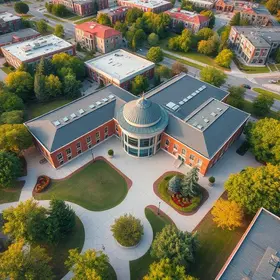
Hesston College

301 South Main
Hesston, KS 67062
Top-Ranked (2026-27): View Rankings
  • Hesston College is a little nugget of paradise located just 30 minutes north of Wichita. As the only two-year college owned by Mennonite Church USA, we offer an environment and learning experience that is hard to match.

School Highlights

Hesston College serves 373 students (98% of students are full-time).
The college's student-teacher ratio of 10:1 is lower than the state community college average of 28:1.
Minority enrollment is 51% of the student body (majority Hispanic), which is more than the state average of 41%.

Quick Facts (26-27)

  • Enrollment: 373 students
  • Private-state tuition: $24,214
  • Student-teacher ratio: 10:1
  • Minority enrollment: 51%
  • Source: Integrated Postsecondary Education Data System (IPEDS)

Top Rankings

Hesston College ranks among the top 20% of public schools in Kansas for:

School Overview

The teacher population of 39 teachers has declined by 66% over five years.
Hesston College
(KS) Community College Avg.
Carnegie Classification
Associate's Colleges
Institution Level
Four or more years
At least 2 but less than 4 years
Institution Control
Private not-for-profit
Public
Total Faculty
39 staff
50 staff
School Calendar
AccreditationAccred.
Higher Learning Commission (HLC)

Student Body

The student population of Hesston College has stayed relatively flat over five years.
The student-teacher ratio of 10:1 has increased from 3:1 over five years.
The Hesston College diversity score of 0.70 is more than the state average of 0.61. The school's diversity has grown by 48% over five years.
Total Enrollment
373 students
1,446 students

Showing 2012–2025. View full 19-year historical data

Student-Teacher Ratio
10:1
28:1
# Full-Time Students
364 students
531 students

Showing 2013–2025. View full 19-year historical data

# Part-Time Students
9 students
915 students

Showing 2012–2025. View full 19-year historical data

# Enrollment Undergraduate
373 students
1,376 students
# Full-Time Undergraduate Students
364 students
529 students

Showing 2013–2025. View full 19-year historical data

# Part-Time Undergraduate Students
9 students
915 students
Total Dormitory Capacity
436 students
365 students

Showing 2010–2025. View full 19-year historical data

% American Indian/Alaskan
1%
1%

Showing 2008–2025. View full 19-year historical data

% Asian
1%
3%

Showing 2008–2025. View full 19-year historical data

% Hispanic
16%
16%
% Black
8%
9%

Showing 2010–2025. View full 19-year historical data

% White
49%
59%

Showing 2010–2025. View full 19-year historical data

% Two or more races
5%
4%
% Non Resident races
17%
2%
% Unknown races
3%
6%
Diversity Score
0.70
0.61

Showing 2011–2025. View full 19-year historical data

College Completion Rate (Students who graduate in less than 4 years)
55%
36%
College Completion Rate (Students who graduate in 4 years or more than 4 years)
0.5797%
n/a
Median Earnings 10 Years After Entry (measured in 2022-2023, in 2024 dollars)
$56,182
$45,120

Points are in the dollars of their own College Scorecard release, and the colleges behind the state line differ by period. The lines do not show inflation-adjusted growth.

Tuition & Financial Aid

The private state tuition of $24,214 is more than the state average of $17,451. The private state tuition has declined by 16% over four years.
Private State Tuition Fees
$24,214
$17,451
Tuition Notes
Full year tuition, b
% Students Receiving Some Financial Aid
100%
90%

Showing 2012–2025. View full 19-year historical data

Median Debt for Graduates
$12,000
$9,071

Showing 2008–2020. View full 14-year historical data

Median Debt for Dropouts
$6,250
$5,467

Showing 2008–2020. View full 14-year historical data

Source: 2025 (or latest year available) Integrated Postsecondary Education Data System (IPEDS)

School Notes

  • With nearly 500 students, you'll find opportunities for life, learning, and leadership that are distinct even among small colleges. With a two-year general studies curriculum, you'll gain the kind of academic and professional preparation that most schools put off until the junior and senior years. With a spiritual dimension that permeates most of what we do, you'll become a valued member of a tightly-knit community of learners, teachers, and friends.

Frequently Asked Questions

How much does Hesston College cost?
Hesston College's private state tuition is approximately $24,214.
What is Hesston College's ranking?
Hesston College ranks among the top 20% of community college in Kansas for: Diversity in US community colleges, Percent of students receiving financial aid and Highest median earnings 10 years after entry.

Recent Articles

Does a College’s Employer Partnership Include Hiring?
A major employer’s logo does not promise a job. Learn how to check hiring commitments, eligibility and access before choosing a community college program.
New vs. Established Career Programs: Which Is Safer?
Compare new and established community college career programs by checking readiness, recent outcomes, staffing and support before you commit to enrollment.
Can Your Career Credential Cross State Lines?
Before choosing a community college career program, check whether its credential meets licensing requirements in another state and what moving could cost.

Quick Facts (26-27)

  • Enrollment: 373 students
  • Private-state tuition: $24,214
  • Student-teacher ratio: 10:1
  • Minority enrollment: 51%
  • Source: Integrated Postsecondary Education Data System (IPEDS)

Related School Videos

Did You Know?

For Kansas public community colleges, the average tuition is approximately $3,402 per year for in-state students and $4,296 for out-of-state students. For private community colleges, the average yearly tuition is approximately $17,451 per year. Read more about average community college tuition costs across the country.

Kansas community colleges have a diversity score of 0.61, which is lower than the national average of 0.74. The most diverse community college in Kansas is Kansas City Kansas Community College. Read more about community college diversity statistics in the USA.

Quick Links